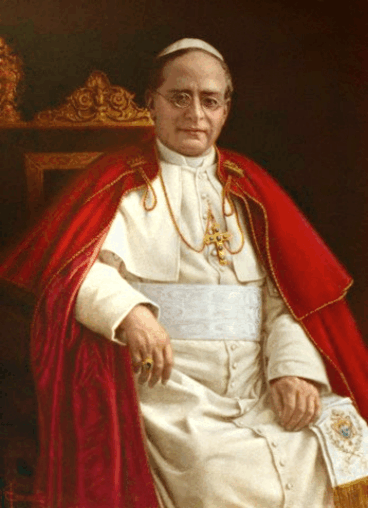
MIT BRENNENDER SORGE
Encyclical of His Holiness
Pope Pius XI
On the Church and the German Reich
March 14, 1937
To the Venerable Brethren the Archbishops
and Bishops of Germany and other
Ordinaries in
Peace and Communion with the Apostolic See.
Venerable Brethren, Greetings, and Apostolic Blessing.
1. It is with
deep anxiety and growing surprise that We have long been following the
painful trials
of the Church and the increasing vexations which afflict those who have
remained loyal
in heart and action in the midst of a people that once received from
St. Boniface the
bright message and the Gospel of Christ and God's Kingdom.
2. And what the
representatives of the venerable episcopate, who visited Us in Our sick
room, had
to tell Us, in truth and duty bound, has not modified Our feelings. To
consoling and
edifying information on the stand the Faithful are making for their
Faith, they considered
themselves bound, in spite of efforts to judge with moderation and in
spite of their
own patriotic love, to add reports of things hard and unpleasant. After
hearing their
account, We could, in grateful acknowledgment to God, exclaim with the
Apostle of love:
"I have no greater grace than this, to hear that my children walk in
truth" (John III. 4).
But the frankness indifferent in Our Apostolic charge and the
determination to place before
the Christian world the truth in all its reality, prompt Us to add:
"Our pastoral heart
knows no deeper pain, no disappointment more bitter, than to learn that
many are straying
from the path of truth."
3. When, in 1933,
We consented, Venerable Brethren, to open negotiations for a concordat,
which
the Reich Government proposed on the basis of a scheme of several
years' standing;
and when, to your unanimous satisfaction, We concluded the negotiations
by a solemn treaty, We were prompted by the desire, as it behooved Us,
interests being Our sole object, that the pacific and maternal hand of the Church would be extended to anyone who did not actually refuse it.
responsibilities and laid bare intrigues, which from the outset only aimed at a war of extermination. In the furrows, where We tried to sow the seed of a sincere peace, other men—the "enemy" of Holy Scripture—oversowed the cockle of distrust, unrest, hatred, defamation, of a determined hostility overt or veiled, fed from many sources and
wielding many tools, against Christ and His Church. They, and they alone with their accomplices, silent or vociferous, are today responsible, should the storm of religious war, instead of the rainbow of peace, blacken the German skies.
5. We have never ceased, Venerable Brethren, to represent to the responsible rulers of your country's destiny, the consequences which would inevitably follow the protection and even the favor, extended to such a policy. We have done everything in Our power to defend the sacred pledge of the given word of honor against theories and practices,
which it officially endorsed, would wreck every faith in treaties and make every signature worthless. Should the day ever come to place before the world the account of Our efforts, every honest mind will see on which side are to be found the promoters of peace, and on which side its disturbers. Whoever had left in his soul an atom of love for
truth, and in his heart a shadow of a sense of justice, must admit that, in the course of these anxious and trying years following upon the conclusion of the concordat, every one of Our words, every one of Our acts, has been inspired by the binding law of treaties. At the same time, anyone must acknowledge, not without surprise and
reprobation, how the other contracting party emasculated the terms of the treaty, distorted their meaning, and eventually considered its more or less official violation as a normal policy. The moderation We showed in spite of all this was not inspired by motives of worldly interest, still less by unwarranted weakness, but merely by Our
anxiety not to draw out the wheat with the cockle; not to pronounce open judgment, before the public was ready to see its force; not to impeach other people's honesty, before the evidence of events should have torn the mask off the systematic hostility leveled at the Church. Even now that a campaign against the confessional schools, which are guaranteed by the concordat, and the destruction of free election, where Catholics have a right to their children's Catholic education, afford evidence, in a matter so essential to the life of the Church, of the extreme gravity of the situation and the anxiety of every Christian conscience; even now Our responsibility for Christian souls induces Us not to overlook the last possibilities, however slight, of a return to fidelity to treaties, and to any arrangement that may be acceptable to the episcopate. We shall continue without failing, to stand before the rulers of your people as the
defender of violated rights, and in obedience to Our Conscience and Our pastoral mission, whether We be successful or not, to oppose the policy which seeks, by open or secret means, to strangle rights guaranteed by a treaty.
6. Different, however, Venerable Brethren, is the purpose of this letter. As you affectionately visited Us in Our illness, so also We turn to you, and through you, the German Catholics, who, like all suffering and afflicted children, are nearer to their Father's heart. At a time when your faith, like gold, is being tested in the fire of tribulation and persecution, when your religious freedom is beset on all sides, when the lack of religious teaching and of normal defense is heavily weighing on you, you have every right to words of truth and spiritual comfort from him whose first predecessor heard these words from the Lord: "I have prayed for thee that thy faith fail not: and thou being once converted, confirm thy brethren" (Luke XXII. 32).
7. Take care, Venerable Brethren, that above all, faith in God, the first and irreplaceable foundation of all religion, be preserved in Germany pure and unstained. The believer in God is not he who utters the name in his speech, but he for whom this sacred word stands for a true and worthy concept of the Divinity. Whoever identifies, by pantheistic confusion, God and the universe, by either lowering God to the dimensions of the world, or raising the world to the dimensions of God, is not a believer in God. Whoever follows that so-called pre-Christian Germanic conception of substituting a dark and impersonal destiny for the personal God, denies thereby the Wisdom and Providence of God who "Reacheth from end to end mightily, and ordereth all things sweetly" (Wisdom VIII. 1). Neither is he a believer in God.
8. Whoever exalts race, or the people, or the State, or a particular form of State, or the depositories of power, or any other fundamental value of the human community—however necessary and honorable be their function in worldly
things—whoever raises these notions above their standard value and divinizes them to an idolatrous level, distorts and perverts an order of the world planned and created by God; he is far from the true faith in God and from the concept of life which that faith upholds.
9. Beware, Venerable Brethren, of that growing abuse, in speech as in writing, of the name of God as though it were a meaningless label, to be affixed to any creation, more or less arbitrary, of human speculation. Use your influence on the Faithful, that they refuse to yield to this aberration. Our God is the Personal God, supernatural, omnipotent, infinitely perfect, one in the Trinity of Persons, tri-personal in the unity of Divine essence, the Creator of all existence. Lord, King and ultimate Consummator of the history of the world, who will not, and cannot, tolerate a rival God by His side.
10. This God, this Sovereign Master, has issued commandments whose value is independent of time and space, country and race. As God's sun shines on every human face so His law knows neither privilege nor exception. Rulers and subjects, crowned and uncrowned, rich and poor are equally subject to His word. From the fullness of the
Creators' right there naturally arises the fullness of His right to be obeyed by individuals and communities, whoever they are. This obedience permeates all branches of activity in which moral values claim harmony with the law of God, and pervades all integration of the ever-changing laws of man into the immutable laws of God.
11. None but superficial minds could stumble into concepts of a national God, of a national religion; or attempt to lock within the frontiers of a single people, within the narrow limits of a single race, God, the Creator of the universe, King and Legislator of all nations before whose immensity they are "as a drop of a bucket" (Isaiah XI, 15).
12. The Bishops of the Church of Christ, "ordained in the things that appertain to God (Heb. V, 1) must watch that pernicious errors of this sort, and consequent practices more pernicious still, shall not gain a footing among their flock. It is part of their sacred obligations to do whatever is in their power to enforce respect for, and obedience to, the commandments of God, as these are the necessary foundation of all private life and public morality; to see that the rights of His Divine Majesty, His name and His word be not profaned; to put a stop to the blasphemies, which, in words and pictures, are multiplying like the sands of the desert; to encounter the obstinacy and provocations of those who deny, despise and hate God, by the never-failing reparatory prayers of the Faithful, hourly rising like incense to the All-Highest and staying His vengeance.
13. We thank you, Venerable Brethren, your priests and Faithful, who have persisted in their Christian duty and in the defense of God's rights in the teeth of an aggressive paganism. Our gratitude, warmer still and admiring, goes out to those who, in fulfillment of their duty, have been deemed worthy of sacrifice and suffering for the love of God.
14. No faith in God can for long survive pure and unalloyed without the support of faith in Christ. "No one knoweth who the Son is, but the Father: and who the Father is, but the Son and to whom the Son will reveal Him" (Luke X. 22). "Now this is eternal life: That they may know thee, the only true God, and Jesus Christ whom thou has sent" (John XVII. 3). Nobody, therefore, can say: "I believe in God, and that is enough religion for me," for the Savior's words brook no evasion: "Whosoever denieth the Son, the same hath not the Father. He that confesseth the Son hath the Father also" (1 John II. 23).
15. In Jesus Christ, Son of God made Man, there shone the plentitude of Divine revelation. "God, who at sundry times and in divers manners, spoke in times past to the fathers by the prophets last of all, in these days hath spoken to us by His Son" (Heb. I. 1). The sacred books of the Old Testament are exclusively the word of God, and constitute a substantial part of his revelation; they are penetrated by a subdued light, harmonizing with the slow development of revelation, the dawn of the bright day of the redemption. As should be expected in historical and didactic books, they reflect in many particulars the imperfection, the weakness and sinfulness of man. But side by side with innumerable touches of greatness and nobleness, they also record the story of the chosen people, bearers of the Revelation and the Promise, repeatedly straying from God and turning to the world. Eyes not blinded by prejudice or passion will see in
this prevarication, as reported by the Biblical history, the luminous splendor of the Divine light revealing the saving plan which finally triumphs over every fault and sin. It is precisely in the twilight of this background that one perceives the striking perspective of the Divine tutorship of salvation, as it warms, admonishes, strikes, raises and beautifies its elect. Nothing but ignorance and pride could blind one to the treasures hoarded in the Old Testament.
16. Whoever wishes to see banished from church and school the Biblical history and the wise doctrines of the Old Testament, blasphemes the name of God, blasphemes the Almighty's plan of salvation, and makes limited and narrow human thought the judge of God's designs over the history of the world: he denies his faith in the true Christ, such
as He appeared in the flesh, the Christ who took His human nature from a people that was to crucify Him; and he understands nothing of that universal tragedy of the Son of God Who to His torturer's sacrilege opposed the Divine and priestly sacrifice of His redeeming death, and made the new alliance the goal of the old alliance, its realization
and its crown.
17. The peak of the revelation as reached in the Gospel of Christ is final and permanent. It knows no retouches by human hand; it admits no substitutes or arbitrary alternatives such as certain leaders pretend to draw from the so-called myth of race and blood. Since Christ, the Lord's Anointed, finished the task of Redemption, and by breaking up the reign of sin deserved for us the grace of being the children God, since that day no other name under heaven has been given to men, whereby we must be saved (Acts IV 12). No man, were every science, power and worldly strength incarnated in him, can lay any other foundation but that which is laid: which is Christ Jesus (1 Cor. III 11). Should any man dare, in sacrilegious disregard of the essential differences between God and His creature, between the God-man and the children of man, to place a mortal, were he the greatest of all times, by the side of, or over, or
against, Christ, he would deserve to be called prophet of nothingness, to whom the terrifying words of Scripture would be applicable: "He that dwelleth in heaven shall laugh at them" (Psalms II. 3).
18. Faith in Christ cannot maintain itself pure and unalloyed without the support of faith in the Church, "the pillar and ground of the truth" (1 Tim. III. 15); for Christ Himself, God eternally blessed, raised this pillar of the Faith. His command to hear the Church (Matt. XVIII. 15), to welcome in the words and commands of the Church His own words and His own commands (Luke X. 16), is addressed to all men, of all times and of all countries. The Church founded by the Redeemer is one, the same for all races and all nations. Beneath her dome, as beneath the vault of heaven, there is but one country for all nations and tongues; there is room for the development of every quality, advantage, task and vocation which God the Creator and Savior has allotted to individuals as well as to ethnical communities. The Church's maternal heart is big enough to see in the God-appointed development of individual characteristics and gifts, more than a mere danger of divergency. She rejoices at the spiritual superiorities among individuals and nations. In their successes she sees with maternal joy and pride fruits of education and progress, which she can only bless and encourage, whenever she can conscientiously do so. But she also knows that to this freedom limits have been set by the majesty of the Divine command, which founded that Church one and indivisible. Whoever tampers with that unity and that indivisibility wrenches from the Spouse of Christ one of the diadems with which God Himself crowned her; he subjects a Divine structure, which stands on eternal foundations, to criticism and transformation by architects whom the Father of Heaven never authorized to interfere.
19. The Church, whose work lies among men and operates through men, may see her Divine mission obscured by human, too human, combination, persistently growing and developing like the cockle among the wheat of the Kingdom of God. Those who know the Savior's words on scandal and the giver of scandals, know, too, the judgment which
the Church and all her sons must pronounce on what was and what is sin. But if, besides these reprehensible discrepancies be between faith and life, acts and words, exterior conduct and interior feelings, however numerous they be, anyone overlooks the overwhelming sum of authentic virtues, of spirit of sacrifice, fraternal love, heroic efforts
of sanctity, he gives evidence of deplorable blindness and injustice. If later he forgets to apply the standard of severity, by which he measures the Church he hates, to other organizations in which he happens to be interested, then his appeal to an offended sense of purity identifies him with those who, for seeing the mote in their brother's eye,
according to the Savior's incisive words, cannot see the beam in their own. But however suspicious the intention of those who make it their task, nay their vile profession, to scrutinize what is human in the Church, and although the priestly powers conferred by God are independent of the priest's human value, it yet remains true that at no moment of history, no individual, in no organization can dispense himself from the duty of loyally examining his conscience, of mercilessly purifying himself, and energetically renewing himself in spirit and in action. In Our Encyclical on the
priesthood We have urged attention to the sacred duty of all those who belong to the Church, chiefly the members of the priestly and religious profession and of the lay apostolate, to square their faith and their conduct with the claims of the law of God and of the Church. And today we again repeat with all the insistency We can command: it is
not enough to be a member of the Church of Christ, one needs to be a living member, in spirit and in truth, i.e., living in the state of grace and in the presence of God, either in innocence or in sincere repentance. If the Apostle of the nations, the vase of election, chastised his body and brought it into subjection: lest perhaps, when he had preached
to others, he himself should become a castaway (1 Cor. IX. 27), could anybody responsible for the extension of the Kingdom of God claim any other method but personal sanctification? Only thus can we show to the present generation, and to the critics of the Church that "the salt of the earth," the leaven of Christianity has not decayed, but is ready to give the men of today—prisoners of doubt and error, victims of indifference, tired of their Faith and straying from God—the spiritual renewal they so much need. A Christianity which keeps a grip on itself, refuses every compromise with the world, takes the commands of God and the Church seriously, preserves its love of God and of men in all its freshness, such a Christianity can be, and will be, a model and a guide to a world which is sick to death and clamors for directions, unless it be condemned to a catastrophe that would baffle the imagination.
20. Every true and lasting reform has ultimately sprung from the sanctity of men who were driven by the love of God and of men. Generous, ready to stand to attention to any call from God, yet confident in themselves because confident in their vocation, they grew to the size of beacons and reformers. On the other hand, any reformatory zeal,
which instead of springing from personal purity, flashes out of passion, has produced unrest instead of light, destruction instead of construction, and more than once set up evils worse than those it was out to remedy. No doubt "the Spirit breatheth where he will" (John III. 8): "of stones He is able to raise men to prepare the way to his designs"
(Matt. III. 9). He chooses the instruments of His will according to His own plans, not those of men. But the Founder of the Church, who breathed her into existence at Pentecost, cannot disown the foundations as He laid them. Whoever is moved by the spirit of God, spontaneously adopts both outwardly and inwardly, the true attitude toward the Church, this sacred fruit from the tree of the cross, this gift from the Spirit of God, bestowed on Pentecost day to an erratic world.
21. In your country, Venerable Brethren, voices are swelling into a chorus urging people to leave the Church, and among the leaders there is more than one whose official position is intended to create the impression that this infidelity to Christ the King constitutes a signal and meritorious act of loyalty to the modern State. Secret and open measures of intimidation, the threat of economic and civic disabilities, bear on the loyalty of certain classes of Catholic functionaries, a pressure which violates every human right and dignity. Our wholehearted paternal sympathy goes out to those who
must pay so dearly for their loyalty to Christ and the Church; but directly the highest interests are at stake, with the alternative of spiritual loss, there is but one alternative left, that of heroism. If the oppressor offers one the Judas bargain of apostasy he can only, at the cost of every worldly sacrifice, answer with Our Lord: "Be gone, Satan! For
it is written: The Lord thy God shalt thou adore, and Him only shalt thou serve" (Matt. IV. 10). And turning to the Church, he shall say: "Thou, my mother since my infancy, the solace of my life and advocate at my death, may my tongue cleave to my palate if, yielding to worldly promises or threats, I betray the vows of my baptism." As to those
who imagine that they can reconcile exterior infidelity to one and the same Church, let them hear Our Lord's warning:—"He that shall deny me before men shall be denied before the angels of God" (Luke XII. 9).
22. Faith in the Church cannot stand pure and true without the support of faith in the primacy of the Bishop of Rome. The same moment when Peter, in the presence of all the Apostles and disciples, confesses his faith in Christ, Son of the Living God, the answer he received in reward for his faith and his confession was the word that built the
Church, the only Church of Christ, on the rock of Peter (Matt. XVI. 18). Thus was sealed the connection between the faith in Christ, the Church and the Primacy. True and lawful authority is invariably a bond of unity, a source of strength, a guarantee against division and ruin, a pledge for the future: and this is verified in the deepest and sublimest sense, when that authority, as in the case of the Church, and the Church alone, is sealed by the promise and the guidance of the Holy Ghost and His irresistible support. Should men, who are not even united by faith in Christ, come and offer you the seduction of a national German Church, be convinced that it is nothing but a denial of the one Church of Christ and the evident betrayal of that universal evangelical mission, for which a world Church alone is qualified and competent. The live history of other national churches with their paralysis, their domestication and subjection to worldly powers, is sufficient evidence of the sterility to which is condemned every branch that is severed from the trunk of the living Church. Whoever counters these erroneous developments with an uncompromising No from the very outset, not only serves the purity of his faith in Christ, but also the welfare and the vitality of his own people.
23. You will need to watch carefully, Venerable Brethren, that religious fundamental concepts be not emptied of their content and distorted to profane use. "Revelation" in its Christian sense, means the word of God addressed to man. The use of this word for the "suggestions" of race and blood, for the irradiations of a people's history, is mere
equivocation. False coins of this sort do not deserve Christian currency. "Faith" consists in holding as true what God has revealed and proposes through His Church to man's acceptance. It is "the evidence of things that appear not" (Heb. II. 1). The joyful and proud confidence in the future of one's people, instinct in every heart, is quite a different thing from faith in a religious sense. To substitute the one for the other, and demand on the strength of this, to be numbered among the faithful followers of Christ, is a senseless play on words, if it does not conceal a confusion of concepts, or worse.
24. "Immortality" in a Christian sense means the survival of man after his terrestrial death, for the purpose of eternal reward or punishment. Whoever only means by the term, the collective survival here on earth of his people for an indefinite length of time, distorts one of the fundamental notions of the Christian Faith and tampers with the very
foundations of the religious concept of the universe, which requires a moral order.
25. "Original sin" is the hereditary but impersonal fault of Adam's descendants, who have sinned in him (Rom. V. 12). It is the loss of grace, and therefore of eternal life, together with a propensity to evil, which everybody must, with the assistance of grace, penance, resistance and moral effort, repress and conquer. The passion and death of the Son of God has redeemed the world from the hereditary curse of sin and death. Faith in these truths, which in your country are today the butt of the cheap derision of Christ's enemies, belongs to the inalienable treasury of Christian revelation.
26. The cross of Christ, though it has become to many a stumbling block and foolishness (1 Cor. I. 23) remains for the believer the holy sign of his redemption, the emblem of moral strength and greatness. We live in its shadow and die in its embrace. It will stand on our grave as a pledge of our faith and our hope in the eternal light.
27. Humility in the spirit of the Gospel and prayer for the assistance of grace are perfectly compatible with self-confidence and heroism. The Church of Christ, which throughout the ages and to the present day numbers more confessors and voluntary martyrs than any other moral collectivity, needs lessons from no one in heroism of feeling and action. The odious pride of reformers only covers itself with ridicule when it rails at Christian humility as though it were but a cowardly pose of self-degradation.
28. "Grace," in a wide sense, may stand for any of the Creator's gifts to His creature; but in its Christian designation, it means all the supernatural tokens of God's love; God's intervention which raises man to that intimate communion of life with Himself, called by the Gospel "adoption of the children of God." "Behold what manner of charity the Father hath bestowed on us, that we should be called and should be the sons of God" (1 John III. 1). To discard this gratuitous and free elevation in the name of a so-called German type amounts to repudiating openly a fundamental truth of
Christianity. It would be an abuse of our religious vocabulary to place on the same level supernatural grace and natural gifts. Pastors and guardians of the people of God will do well to resist this plunder of sacred things and this confusion of ideas.
29. It is on faith in God, preserved pure and stainless, that man's morality is based. All efforts to remove from under morality and the moral order the granite foundation of faith and to substitute for it the shifting sands of human regulations, sooner or later lead these individuals or societies to moral degradation. The fool who has said in his heart
"there is no God" goes straight to moral corruption (Psalms XIII. 1), and the number of these fools who today are out to sever morality from religion, is legion. They either do not see or refuse to see that the banishment of confessional Christianity, i.e., the clear and precise notion of Christianity, from teaching and education, from the organization of social and political life, spells spiritual spoliation and degradation. No coercive power of the State, no purely human ideal, however noble and lofty it be, will ever be able to make shift of the supreme and decisive impulses generated by faith in God and Christ. If the man, who is called to the hard sacrifice of his own ego to the common
good, loses the support of the eternal and the divine, that comforting and consoling faith in a God who rewards all good and punishes all evil, then the result of the majority will be, not the acceptance, but the refusal of their duty. The conscientious observation of the ten commandments of God and the precepts of the Church (which are nothing but practical specifications of rules of the Gospels) is for every one an unrivaled school of personal discipline, moral education and formation of character, a school that is exacting, but not to excess. A merciful God, who as Legislator, says—Thou must!—also gives by His grace the power to will and to do. To let forces of moral formation of such efficacy lie fallow, or to exclude them positively from public education, would spell religious under-feeding of a nation. To hand over the moral law to man's subjective opinion, which changes with the times, instead of anchoring it in the holy will of the eternal God and His commandments, is to open wide every door to the forces of destruction. The resulting dereliction of the eternal principles of an objective morality, which educates conscience and ennobles every department and organization of life, is a sin against the destiny of a nation, a sin whose bitter fruit will poison future
generations.
30. Such is the rush of present-day life that it severs from the divine foundation of Revelation, not only morality, but also the theoretical and practical rights. We are especially referring to what is called the natural law, written by the Creator's hand on the tablet of the heart (Rom. II. 14) and which reason, not blinded by sin or passion, can easily read. It is in the light of the commands of this natural law, that all positive law, whoever be the lawgiver, can be gauged in its moral content, and hence, in the authority it wields over conscience. Human laws in flagrant contradiction with the natural law are vitiated with a taint which no force, no power can mend. In the light of this principle one must judge the axiom, that "right is common utility," a proposition which may be given a correct significance, it means that what is morally indefensible, can never contribute to the good of the people. But ancient paganism acknowledged that the axiom, to be entirely true, must be reversed and be made to say: "Nothing can be useful, if it is not at the same time morally good" (Cicero, De Off. II. 30). Emancipated from this oral rule, the principle would in international law carry a perpetual state of war between nations; for it ignores in national life, by confusion of right and utility, the basic
fact that man as a person possesses rights he holds from God, and which any collectivity must protect against denial, suppression or neglect. To overlook this truth is to forget that the real common good ultimately takes its measure from man's nature, which balances personal rights and social obligations, and from the purpose of society,
established for the benefit of human nature. Society, was intended by the Creator for the full development of individual possibilities, and for the social benefits, which by a give and take process, every one can claim for his own sake and that of others. Higher and more general values, which collectivity alone can provide, also derive from the
Creator for the good of man, and for the full development, natural and supernatural, and the realization of his perfection. To neglect this order is to shake the pillars on which society rests, and to compromise social tranquillity, security and existence.
31. The believer has an absolute right to profess his Faith and live according to its dictates. Laws which impede this profession and practice of Faith are against natural law. Parents who are earnest and conscious of their educative duties, have a primary right to the education of the children God has given them in the spirit of their Faith, and
according to its prescriptions. Laws and measures which in school questions fail to respect this freedom of the parents go against natural law, and are immoral. The Church, whose mission it is to preserve and explain the natural law, as it is Divine in its origin, cannot but declare that the recent enrollment into schools organized without a
semblance of freedom, is the result of unjust pressure, and is a violation of every common right.
32. As the Vicar of Him who said to the young man of the Gospel: "If thou wilt enter into life, keep the commandments" (Matt. XIX. 17), We address a few paternal words to the young.
33. Thousands of voices ring into your ears a Gospel which has not been revealed by the Father of Heaven. Thousands of pens are wielded in the service of a Christianity, which is not of Christ. Press and wireless daily force on you productions hostile to the Faith and to the Church, impudently aggressive against whatever you should hold
venerable and sacred. Many of you, clinging to your Faith and to your Church, as a result of your affiliation with religious associations guaranteed by the concordat, have often to face the tragic trial of seeing your loyalty to your country misunderstood, suspected, or even denied, and of being hurt in your professional and social life. We are well aware that there is many a humble soldier of Christ in your ranks, who with torn feelings, but a determined heart, accepts his fate, finding his one consolation in the thought of suffering insults for the name of Jesus (Acts V. 41). Today, as We see you threatened with new dangers and new molestations, We say to you: If any one should preach to you a Gospel other than the one you received on the knees of a pious mother, from the lips of a believing father, or through teaching faithful to God and His Church, "let him be anathema" (Gal. I. 9). If the State organizes a national youth, and
makes this organization obligatory to all, then, without prejudice to rights of religious associations, it is the absolute right of youths as well as of parents to see to it that this organization is purged of all manifestations hostile to the Church and Christianity. These manifestations are even today placing Christian parents in a painful alternative, as they cannot give to the State what they owe to God alone.
34. No one would think of preventing young Germans establishing a true ethnical community in a noble love of freedom and loyalty to their country. What We object to is the voluntary and systematic antagonism raised between national education and religious duty. That is why we tell the young: Sing your hymns to freedom, but do not forget the freedom of the children of God. Do not drag the nobility of that freedom in the mud of sin and sensuality. He who sings hymns of loyalty to this terrestrial country should not, for that reason, become unfaithful to God and His Church, or a deserter and traitor to His heavenly country. You are often told about heroic greatness, in lying
opposition to evangelical humility and patience. Why conceal the fact that there are heroisms in moral life? That the preservation of baptismal innocence is an act of heroism which deserves credit? You are often told about the human deficiencies which mar the history of the Church: why ignore the exploits which fill her history, the Saints she begot, the blessing that came upon Western civilization from the union between that Church and your people? You are told about sports. Indulged in with moderation and within limits, physical education is a boon for youth. But so much time is now devoted to sporting activities, that the harmonious development of body and mind is disregarded, that duties to one's family, and the observation of the Lord's Day are neglected. With an indifference bordering on contempt the day of the Lord is divested of its sacred character, against the best of German traditions. But We expect the Catholic youth, in the more favorable organizations of the State, to uphold its right to a Christian sanctification of the Sunday, not to exercise the body at the expense of the immortal soul, not to be overcome by evil, but to aim at the triumph of good over evil (Rom. XII. 21) as its highest achievement will be the gaining of the crown in the stadium of eternal life (1 Cor. IX. 24).
35. We address a special word of congratulation, encouragement and exhortation to the priests of Germany, who, in difficult times and delicate situations, have, under the direction of their Bishops, to guide the flocks of Christ along the straight road, by word and example, by their daily devotion and apostolic patience. Beloved sons, who participate with Us in the sacred mysteries, never tire of exercising, after the Sovereign and eternal Priest, Jesus Christ, the charity and solicitude of the Good Samaritan. Let your daily conduct remain stainless before God and the incessant pursuit of your
perfection and sanctification, in merciful charity towards all those who are confided to your care, especially those who are more exposed, who are weak and stumbling. Be the guides of the faithful, the support of those who fail, the doctors of the doubting, the consolers of the afflicted, the disinterested counselors and assistants of all. The trials
and sufferings which your people have undergone in post-war days have not passed over its soul without leaving painful marks. They have left bitterness and anxiety which are slow to cure, except by charity. This charity is the apostle's indispensable weapon, in a world torn by hatred. It will make you forget, or at least forgive, many an undeserved insult now more frequent than ever.
36. This charity, intelligent and sympathetic towards those even who offend you, does by no means imply a renunciation of the right of proclaiming, vindicating and defending the truth and its implications. The priest's first loving gift to his neighbors is to serve truth and refute error in any of its forms. Failure on this score would be not only a betrayal of God and your vocation, but also an offense against the real welfare of your people and country. To all those who have kept their promised fidelity to their Bishops on the day of their ordination; to all those who in the exercise of their priestly function are called upon to suffer persecution; to all those imprisoned in jail and concentration
camps, the Father of the Christian world sends his words of gratitude and commendation.
37. Our paternal gratitude also goes out to Religious and nuns, as well as Our sympathy for so many who, as a result of administrative measures hostile to Religious Orders, have been wrenched from the work of their vocation. If some have fallen and shown themselves unworthy of their vocation, their fault, which the Church punishes, in no way detracts from the merit of the immense majority, who, in voluntary abnegation and poverty, have tried to serve their God and their country. By their zeal, their fidelity, their virtue, their active charity, their devotion, the Orders devoted to the care of souls, the service of the sick and education, are greatly contributing to private and public welfare. No doubt better days will come to do them better justice than the present troublous times have done. We trust that the heads of religious communities will profit by their trials and difficulties to renew their zeal, their spirit of prayer, the austerity of their lives and their perfect discipline, in order to draw down God's blessing upon their difficult work.
38. We visualize the immense multitudes of Our faithful children, Our sons and daughters, for whom the sufferings of the Church in Germany and their own have left intact their devotion to the cause of God, their tender love for the Father of Christendom, their obedience to their pastors, their joyous resolution to remain ever faithful, happen what may, to the sacred inheritance of their ancestors. To all of them We send Our paternal greetings. And first to the members of those religious associations which, bravely and at the cost of untold sacrifices, have remained faithful
to Christ, and have stood by the rights which a solemn treaty had guaranteed to the Church and to themselves according to the rules of loyalty and good faith.
39. We address Our special greetings to the Catholic parents. Their rights and duties as educators, conferred on them by God, are at present the stake of a campaign pregnant with consequences. The Church cannot wait to deplore the devastation of its altars, the destruction of its temples, if an education, hostile to Christ, is to profane the temple of the child's soul consecrated by baptism, and extinguish the eternal light of the faith in Christ for the sake of counterfeit light alien to the Cross. Then the violation of temples is nigh, and it will be every one's duty to sever his responsibility from the opposite camp, and free his conscience from guilty cooperation with such corruption. The more the enemies attempt to disguise their designs, the more a distrustful vigilance will be needed, in the light of bitter experience. Religious lessons maintained for the sake of appearances, controlled by unauthorized men, within the frame of an
educational system which systematically works against religion, do not justify a vote in favor of non-confessional schools. We know, dear Catholic parents, that your vote was not free, for a free and secret vote would have meant the triumph of the Catholic schools. Therefore, we shall never cease frankly to represent to the responsible authorities the iniquity of the pressure brought to bear on you and the duty of respecting the freedom of education. Yet do not forget this: none can free you from the responsibility God has placed on you over your children. None of your oppressors, who pretend to relieve you of your duties can answer for you to the eternal Judge, when he will ask: "Where are those I confided to you?" May every one of you be able to answer:
"Of them whom thou hast given me, I have not lost any one" (John XVIII. 9).
40. Venerable Brethren, We are convinced that the words which in this solemn moment We address to you, and to the Catholics of the German Empire, will find in the hearts and in the acts of Our Faithful, the echo responding to the solicitude of the common Father. If there is one thing We implore the Lord to grant, it is this, that Our words may
reach the ears and the hearts of those who have begun to yield to the threats and enticements of the enemies of Christ and His Church.
41. We have weighed every word of this letter in the balance of truth and love. We wished neither to be an accomplice to equivocation by an untimely silence, nor by excessive severity to harden the hearts of those who live under Our pastoral responsibility; for Our pastoral love pursues them none the less for all their infidelity. Should those who are trying to adapt their mentality to their new surroundings, have for the paternal home they have left and for the Father Himself, nothing but words of distrust, in gratitude or insult, should they even forget whatever they forsook, the day will come when their anguish will fall on the children they have lost, when nostalgia will bring them back to "God who was the joy of their youth," to the Church whose paternal hand has directed them on the road that leads to the Father of Heaven.
42. Like other periods of the history of the Church, the present has ushered in a new ascension of interior purification, on the sole condition that the faithful show themselves proud enough in the confession of their faith in Christ, generous enough in suffering to face the oppressors of the Church with the strength of their faith and charity. May the holy time of Lent and Easter, which preaches interior renovation and penance, turn Christian eyes towards the Cross and the risen Christ; be for all of you the joyful occasion that will fill your souls with heroism, patience and victory. Then We are sure, the enemies of the Church, who think that their time has come, will see that their joy
was premature, and that they may close the grave they had dug. The day will come when the Te Deum of liberation will succeed to the premature hymns of the enemies of Christ: Te Deum of triumph and joy and gratitude, as the German people return to religion, bend the knee before Christ, and arming themselves against the enemies of
God, again resume the task God has laid upon them.
43. He who searches the hearts and reins (Psalm VII. 10) is Our witness that We have no greater desire than to see in Germany the restoration of a true peace between Church and State. But if, without any fault of Ours, this peace is not to come, then the Church of God will defend her rights and her freedom in the name of the Almighty Whose arm has not shortened. Trusting in Him, "We cease not to pray and to beg" (Col. I. 9) for you, children of the Church, that the days of tribulation may end and that you may be found faithful in the day of judgment; for the persecutors and oppressors, that the Father of light and mercy may enlighten them as He enlightened Saul on the road of Damascus. With this prayer in Our heart and on Our lips We grant to you, as a pledge of Divine help, as a support in your difficult resolutions, as a comfort in the struggle, as a consolation in all trials, to You, Bishops and Pastors of the Faithful, priests, Religious, lay apostles of Catholic Action, to all your diocesans, and specially to the sick and the prisoners, in paternal love, Our Apostolic Benediction.
Given at the Vatican on Passion Sunday, 14 March 1937.
www.catholictradition.org/Encyclicals/mit.htm