

Love Begins With a Dream
byBishop Fulton J. Sheen

1952
TAKEN FROM THE WORLD'S FIRST LOVE
Every person carries within his heart a blueprint of the one he loves. What seems to be "love at first sight" is actually the fulfillment of desire, the realization of a dream. Plato, sensing this, said that all knowledge is recollection from a previous existence. This is not true as he states it, but it is true if one understands it to mean that we already have an ideal in us -— one which is made by our thinking, our habits, our experiences, and our desires. Otherwise how would we know immediately, on seeing persons or things, that we loved them? Before meeting certain people we already have a pattern and mold of what we like and what we do not like, certain persons fit into that pattern, others do not.
When we hear music for the first time, we either like or dislike it. We judge it by the music we already have heard in our own hearts. Jittery minds, which cannot long repose in one object of thought or in continuity of an ideal, love music which is distracting, excited, and jittery. Calm minds like calm music: the heart has its own secret melody, and one day when the score is played the heart answers, "This is it." So it is with love. A tiny architect works inside the human heart drawing sketches of the ideal love from the people it sees, from the books it reads, from its hopes and daydreams, in the fond hope that the eye may one day see the ideal and the hand touch it. Life becomes satisfying the moment the dream is seen walking, and the person appears as the incarnation of all that one loves. The liking is instantaneous -— because, actually, it has been there waiting for a long time. Some go through life without ever meeting what they call their ideal. This could be very disappointing, if the ideal never really existed. ut the absolute ideal of every heart does exist, and it is God. All human love is an invitation into the Eternal. Some find the Ideal in substance without passing through the shadow.
God, too, has within Himself blueprints of everything in the universe. As the architect has in his mind a plan of the house before the house is built, so God has in His Mind an archetypal idea of every flower, bird, tree, springtime, and melody. There never was a brush touched to canvas nor a chisel to marble without some great pre-existing idea. So, too, every atom and every rose is realization and concretion of an idea existing in the Mind of God from all eternity. All creatures below man correspond to the pattern God has in His Mind. A tree is truly a tree because it corresponds to God's idea of a tree. A rose is a rose because its is God's idea of a rose wrapped up in chemicals and tints and life. But it is not so with persons. God has to have two pictures of us: one is what we are, and the other is what we ought to be. He has the model, and He has the reality: the blueprint and the edifice, the score of the music and the way we play it. God has to have these two pictures because in each and every one of us there is some disproportion and want of conformity between the original plan and the way we have worked it out. The image is blurred; the print is faded. For one thing, our personality is not complete in time; we need a renewed body. Then, too, our sins diminish our personality; our evil acts daub the canvas the Master Hand designed. Like unhatched eggs, some of us refuse to be warmed by the Divine Love, which is so necessary for incubation to a higher level. We are in constant need of repairs; our free acts do not coincide with the law of our being; we fall short of all God wants us to be. St. Paul tells us that we were predestined, before the foundations of the world were laid, to become the sons of God. But some of us will not fulfill that hope.
There is, actually, only one person in all humanity of whom God has one picture and in whom there is a perfect conformity between what He wanted her to be and what she is, and that is His Own Mother. Most of us are a minus sign, in the sense that we do not fulfill the high hopes the Heavenly Father has for us. But Mary is the equal sign. The Ideal that God had of her, that she is, and in the flesh. The model and the copy are perfect; she is all that was foreseen, planned, and dreamed. The melody of her life is played just as it was written. Mary was thought, conceived, and planned as the equal sign between ideal and history, thought and reality, hope and realization.
That is why, through the centuries, Christian liturgy has applied to her the words of the Book of Proverbs. Because she is what God wanted us all to be, she speaks of herself as the Eternal blueprint in the Mind of God, the one whom God loved before she was a creature. She is even pictured as being with Him not only at creation but also before creation. She existed in the Divine Mind as an Eternal Thought before there were any mothers. She is the Mother of mothers -— she is the world's first love.
"The Lord possessed me in the beginning of His ways, before He made anything, from the beginning. I was set up from eternity, and of old, before the earth was made. The depths were not as yet, and I was already conceived; neither had the fountains of waters as yet sprung out; the mountains with their huge bulk had not as yet been established: before the hills I was brought forth. He had not yet made the earth, or the rivers, or the poles of the world. When He prepared the heavens, I was present; when with a certain law and compass He enclosed the depths; when He established the sky above and poised the fountains of waters; when He compassed the sea with its bounds and set a law to the waters that they should not pass their limits; when He balanced the foundations of the earth; I was with Him, forming all things, and was delighted every day, playing before Him at all times, playing in the world: and my delights were to be with the children of men. Now, therefore, ye children, hear me: Blessed are they that keep my ways. Hear instruction, and be wise, and refuse it not. Blessed is the man that heareth me and that watcheth daily at my gates and waiteth at the posts of my doors. He that shall find me shall find life and shall have salvation from the Lord" (Prov 8:22-35).
But God not only thought of her in eternity; He also had her in mind at the beginning of time. In the beginning of history, when the human race fell through the solicitation of a woman, God spoke to the Devil and said, "I will establish a feud between thee and the woman, between thy offspring and hers; she is to crush thy head, while thou dost lie in wait at her heels" (Gen. 3:15). God was saying that, if it was by a woman that man fell, it would be through a woman that God would be revenged. Whoever His Mother would be, she would certainly be blessed among women, and because God Himself chose her, He would see to it that all generations would call her blessed.
When God willed to become Man, He had to decide on the time of His coming, the country in which He would be born, the city in which He would be raised, the people, the race, the political and economic systems that would surround Him, the language He would speak, and the psychological attitudes with which He would come in contact as the Lord of History and the Savior of the World.
All these details would depend entirely on one factor: the woman who would be His Mother. To choose a mother is to choose a social position, a language, a city, an environment, a crisis, and a destiny.
His Mother was not like ours, whom we accepted as something historically fixed, which we could not change; He was born of a Mother whom He chose before He was born. It is the only instance in history where both the Son willed the Mother and the Mother willed the Son. And this is what the Creed means when it says "born of the Virgin Mary." She was called by God as Aaron was, and Our Lord was born not just of her flesh but also by her consent.
Before taking unto Himself a human nature, He consulted with the Woman, to ask her if she would give Him a man. The Manhood of Jesus was not stolen from humanity, as Prometheus stole fire from heaven; it was given as a gift.
The first man, Adam, was made from the slime of the earth. The first woman was made from a man in an ecstasy. The new Adam, Christ, comes from the new Eve, Mary, in an ecstasy of prayer and love of God and the fullness of freedom.
We should not be surprised that she is spoken of as a thought by God before the world was made. When Whistler painted the picture of his mother, did he not have the image of her in his mind before he ever gathered his colors on his palette? If you could have preexisted your mother (not artistically, but really), would you not have made her the most perfect woman that ever lived -— one so beautiful she would have been the sweet envy of all women, and one so gentle and so merciful that all other mothers would have sought to imitate her virtues? Why, then, should we think that God would do otherwise? When Whistler was complimented on the portrait of his mother, he said, "You know how it is; one tries to make one's Mummy just as nice as he can." When God became Man, He too, I believe, would make His Mother as nice as He could -— and that would make her a perfect Mother.
God never does anything without exceeding preparation. The two great masterpieces of God are Creation of man and Re-creation or Redemption of man. Creation was made for unfallen men; His Mystical Body, for fallen men. Before making man, God made a garden of delights -— as God alone knows how to make a garden beautiful. In that Paradise of Creation there were celebrated the first nuptials of man and woman. But man willed not to have blessings, except according to his lower nature. Not only did he lose his happiness; he even wounded his own mind and will. Then God planned the remaking or redeeming of man. But before doing so, he would make another Garden. This new one would be not of earth but of flesh; it would be a Garden over whose portals the name of sin would never be written -— a Garden in which there would grow no weeds of rebellion to choke the growth of the flowers of grace -— a Garden from which there would flow four rivers of redemption to the four corners of the earth -— a Garden so pure that the Heavenly Father would not blush at sending His Own Son into it -— and this "flesh-girt Paradise to be gardened by the Adam new" was Our Blessed Mother.
VIEW AN ICON OF THIS GARDEN

As Eden was the Paradise of Creation, Mary is the Paradise of the Incarnation, and in her as a Garden were celebrated the first nuptials of God and man. The closer one gets to fire, the greater the heat; the closer one is to God, the greater the purity. But since no one was ever closer to God than the woman whose human portals He threw open to walk this earth, then no one could have been more pure than she.
A garden bower in flower
Grew waiting for God's hand:
Where no man ever trod,
This was the Gate of God.
The first bower was red -—
Her lips which "welcome" said.
The second bower was blue -—
Her eyes that let God through.
The third bower was white -—
Her soul in God's sight.
Three bowers of love
Now Christ from Heaven above.
-— LAWRENCE HOUSMAN
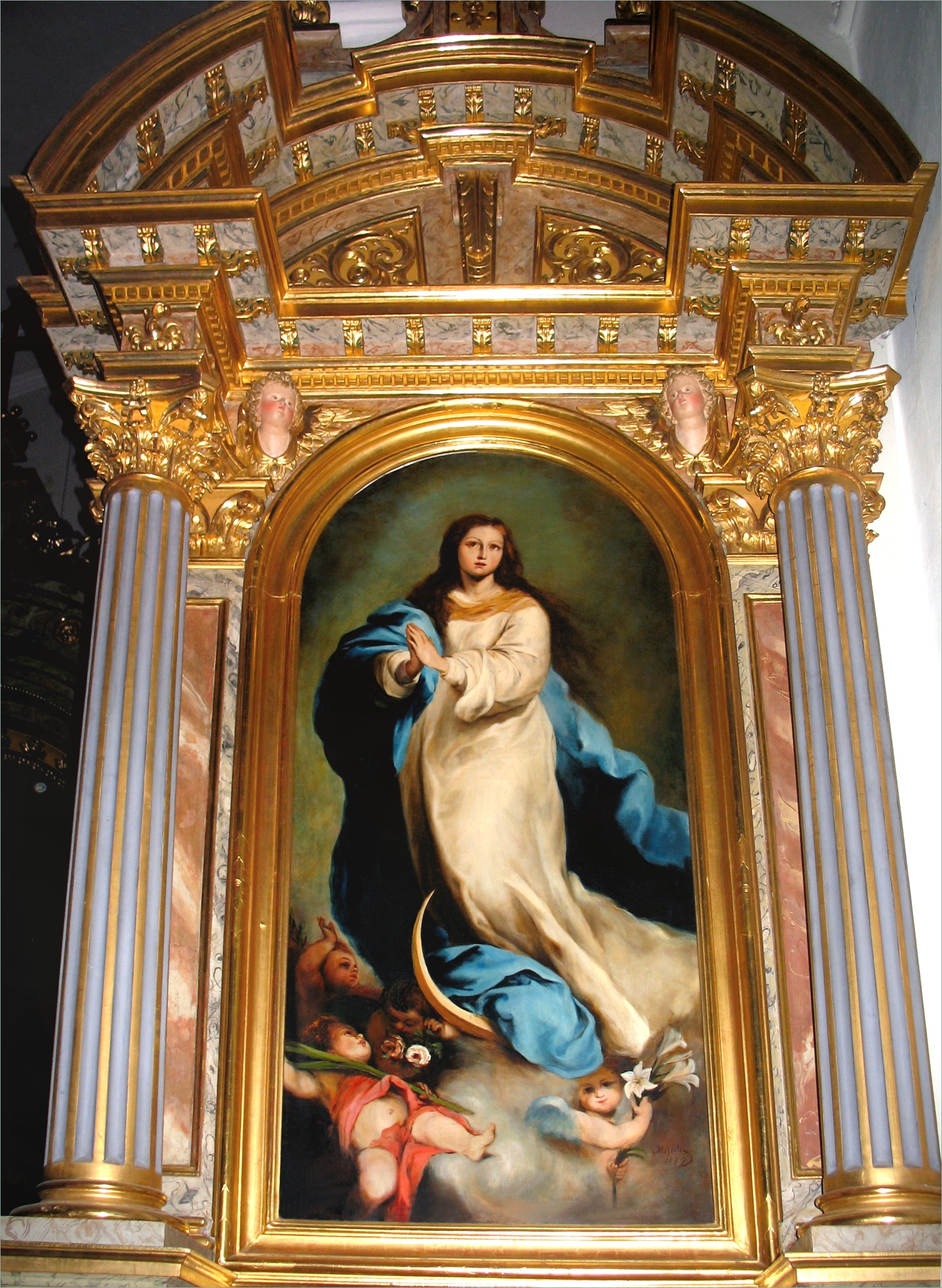
This special purity of hers we call the Immaculate Conception. It is not the Virgin Birth. The word "immaculate" is taken from two Latin words meaning "not stained." "Conception" means that, at the first moment of her conception, the Blessed Mother in the womb of her mother, St. Anne, and in virtue of the anticipated merits of the Redemption of her Son, was preserved free from the stains of Original Sin.
I never could see why anyone in this day and age should object to the Immaculate Conception; all modern pagans believe that they are immaculately conceived. If there is no Original Sin, then everyone is immaculately conceived. Why do they shrink from allowing to Mary what they attribute to themselves? The doctrine of Original Sin and the Immaculate Conception are mutually exclusive. If Mary alone is the Immaculate Conception, then the rest of us must have Original Sin.
The Immaculate Conception does not imply that Mary needed no Redemption. She needed it as much as you and I do. She was redeemed in advance, by way of prevention, in both body and soul, in the first instant of conception. We receive the fruits of redemption in our soul at Baptism. The whole human race needs redemption. But Mary was de-solidarized and separated from that sin -— laden humanity as a result of the merits of Our Lord's Cross being offered to her at the moment of her conception. If we exempted her from the need of redemption, we would also have to exempt her from membership in humanity. The Immaculate Conception, therefore, in no way implies that she needed no redemption. She did! Mary is the first effect of redemption, in the sense that it was applied to her at the moment of her conception and to us in another and diminished fashion only after our birth.
She had this privilege, not for her sake, but for His sake. That is why those who do not believe in the Divinity of Christ can see no reason for the special privilege accorded to Mary. If I did not believe in the Divinity of Our Lord -— which God avert -— I should see nothing but nonsense in any special reverence given to Mary above the other women on earth! But if she is the Mother of God, Who became Man, then she is unique, and then she stands out as the new Eve of Humanity -— as He is the new Adam.
There had to be some such creature as Mary -— otherwise God would have found no one in whom He could fittingly have taken His human origin. An honest politician seeking civic reforms looks about for honest assistants. The Son of God beginning a new creation searched for some of that Goodness which existed before sin took over. There would have been, in some minds, a doubt about the Power of God if He had not shown a special favor to the woman who was to be His Mother. Certainly what God gave to Eve, He would not refuse to His Own Mother.
Suppose that God in making over man did not also make over woman into a new Eve! What a howl of protest would have gone up! Christianity would have been denounced as are all male religions. Women would then have searched for a female religion! It would have been argued that woman was always the slave of man and even God intended her to be such, since He refused to make the new Eve as He made the new Adam.
Had there been no Immaculate Conception, then Christ would have been said to be less beautiful, for He would have taken His Body from one who was not humanly perfect! There ought to be an infinite separation between God and sin, but there would not have been if there was not one Woman who could crush the cobra's head.
VIEW AN IMAGE OF THE IMMACULATE CONCEPTION BY JOSEF M. LUSENBERG, 1876
CLICK HERE FOR AN EXTERNAL LINK TO OTHER MARIAN IMAGES OF HIS,
JUST SCROLL DOWN TO GALLERY
If you were an artist, would you allow someone to prepare your canvas with daubs? Then why should God be expected to act differently when He prepares to unite to Himself a human nature like ours, in all things, save sin? But having lifted up one woman by preserving her from sin, and then having her freely ratify that gift at the Annunciation, God gave hope to our disturbed, neurotic, gauche, and weak humanity. Oh, yes! He is our Model, but He is also the Person of God! There ought to be, on the human level, Someone who would give humans hope, Someone who could lead us to Christ, Someone who would mediate between us and Christ as He mediates between us and the Father. One look at her, and we know that a human who is not good can become better; one prayer to her, and we know that, because she is without sin, we can become less sinful.
And that brings us back to the beginning. We have said that everyone carries within his heart a blueprint of his ideal love. The best of human loves, no matter how devoted they be, must end -— nd there is nothing perfect that ends. If there be anyone of whom it is possible to say, "This is the last embrace," then there is no perfect love. Hence some, ignoring the Divine, may try to have a multiplicity of loves make up for the ideal love; but this is like saying that to render a musical masterpiece one must play a dozen different violins.
Every man who pursues a maid, every maid who yearns to be courted, every bond of friendship in the universe, seeks a love that is not just her love or his love but something that overflows both her and him that is called "our love." Everyone is in love with an ideal love, a love that is so far beyond sex that sex is forgotten. We all love something more than we love. When that overflow ceases, love stops. As the poet puts it: "I could not love thee, dear, so much, loved I not honor more." That ideal love we see beyond all creature-love, to which we instinctively turn when flesh-love fails, is the same ideal that God had in His Heart from all eternity -— the Lady whom He calls "Mother." She is the one whom every man loves when he loves a woman -— whether he knows it or not. She is what every woman wants to be when she looks at herself. She is the woman whom every man marries in ideal when he takes a spouse; she is hidden as an ideal in the discontent of every woman with the carnal aggressiveness of man; she is the secret desire every woman has to be honored and fostered; she is the way every woman wants to command respect and love because of the beauty of her goodness of body and soul. And this blueprint love, whom God loved before the world was made, this Dream Woman before women were, is the one of whom every heart can say in its depth of depths: "She is the woman I love!"
DOWNLOAD THE IMAGE PLAIN, WITHOUT THE FRAME AND ORBS

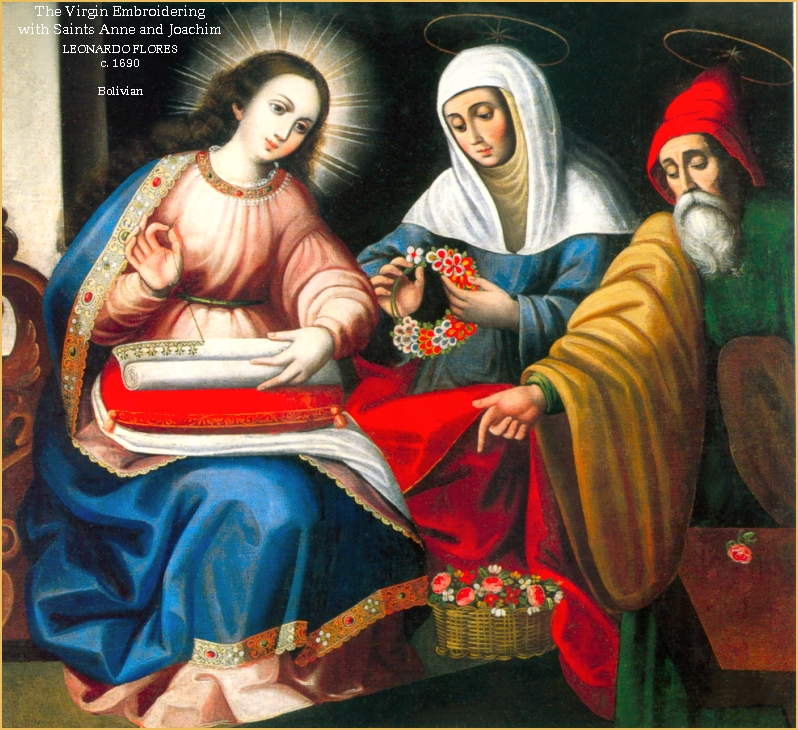
VIEW AN IMAGE OF THE VIRGIN WITH ST. ANNE AND ST. JOACHIM
 E-MAIL
HOME----------------------------MARY, HOPE OF SINNERS
www.catholictradition.org/Mary/dream.htm